

Honoring Queer History: How Local Media Helped Maine’s LGBTQ+ Community Find Connection, Safety, and Pride
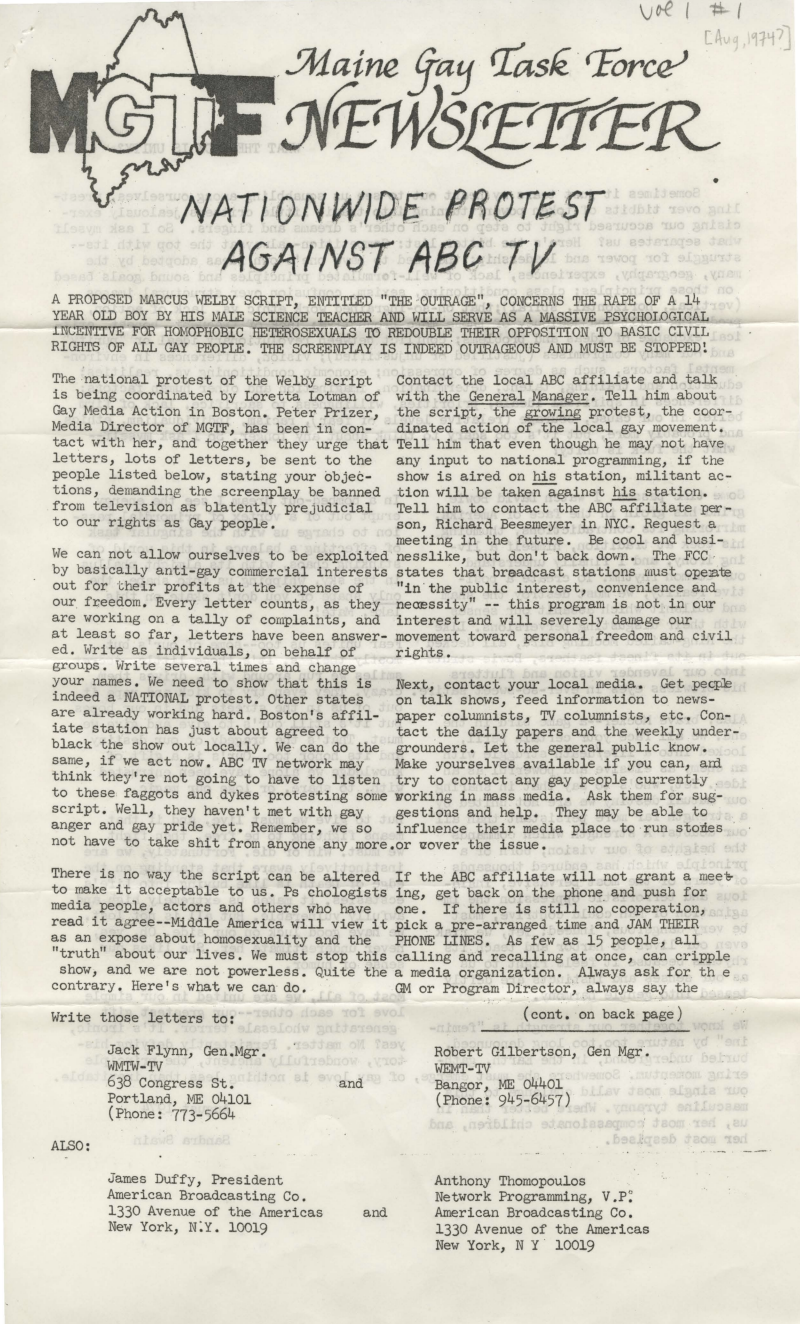
Maine Gay Task Force Newsletter August 1974, Vol 1 Issue 1 Calls for protests to ABC and affiliates for negative portrayals of gay men in mainstream media
In this special Pride Month edition of Fireside, I had the joy of sitting down with my friend and fellow history buff Megan Mac Gregor to explore a subject close to both our hearts—queer media. Specifically, we dove into the remarkable role local queer media has played in shaping, documenting, and sustaining queer communities here in Maine.
Megan and I both serve on the advisory board for the LGBTQ+ Collection at the Jean Byers Sampson Center for Diversity in Maine, the largest repository of queer history in the state. From 43 queer newspapers archived in the collection to the grassroots newsletters that kept folks informed in the pre-Internet era, we talked about how media has long been a tool for resistance, connection, and celebration in LGBTQ+ communities.
“Even from the start, it was a call to action,” Megan said, referring to the Main Gay Task Force Newsletter, the state’s first queer publication. “The first article in the first issue was a protest against an ABC drama perpetuating harmful stereotypes about queer people. The media was how we rallied, informed each other, and pushed back.”
When Representation Was a Lifeline
The conversation brought to life the underground zines, grassroots newsletters, and independent queer newspapers that once formed the backbone of LGBTQ+ information sharing in Maine. These weren’t just papers—they were lifelines.
“Some were radical manifestos,” Megan explained. “Others were more like traditional newspapers with editorials, letters to the editor, calendars of events, and ads for local queer-friendly businesses. And then some were simple newsletters from community orgs. But what they all had in common was a deep commitment to connection.”
In the days before social media or mainstream LGBTQ+ visibility, these publications helped people find each other. They told the stories traditional media ignored—or worse, twisted.
“The murder of Charlie Howard in Bangor in 1984 barely got attention in local press,” Megan recalled. “But in our community papers, it was front-page news for months. The queer media held space for the outrage and grief, and it helped catalyze the next wave of activism.”
The Importance of Preserving Queer Media
One of the most surprising revelations? Maine had 43 queer publications over the decades—an extraordinary number, especially for a rural state. And what makes Maine especially unique is that we kept them. Thanks to the LGBTQ+ Collection at USM, every one of those papers has been digitized and is now accessible online.
“We don’t really know how many queer publications existed in other states, because so many were lost,” Megan shared. “Sometimes they were intentionally destroyed—out of fear, shame, or privacy. Sometimes they just disappeared because people didn’t realize their value.”
That’s what makes the work of the collection—and community contributions—so critical. Preserving these papers isn’t just about nostalgia. It’s about identity, belonging, and the power of representation.
What We Lose When Local Queer Media Disappears
As we reflected on the fading of queer print publications, Megan shared a potent insight: “Those papers pulled everything together. You’d turn to the back page and see every queer event in the state listed. One glance and you knew what was happening, where to be, and how to get involved. That kind of visibility—centralized and community-focused—is hard to replicate today.”
Now, with so much of our communication scattered across social media platforms and email lists, it’s easy to miss what’s happening, especially for those new to the area or without existing community ties.
“We’ve lost that central place,” Megan said. “And I think that loss has a real impact on how people connect and mobilize today.”
History That’s Still Being Written
If you live in Maine—or have roots here—you can help ensure this history continues to be told. The LGBTQ+ Collection is still growing, and we welcome stories, materials, memorabilia, and memories. Every photo, flyer, and letter helps deepen the collective understanding of what it has meant—and still means—to be queer in Maine.
As Megan reminded us, history isn’t just about the past. It’s about shaping the future.
“Each generation pushes us forward. The kids showing up today at Pride expect more, dream bigger, because those before them fought for that possibility.”
Want to Dive In?
You can explore the entire archive of digitized queer newspapers online here.
And if you’re in Maine, come say hi! Megan and I will be tabling on behalf of the LGBTQ+ Collection:
Brunswick Pride – June 14
Portland Pride – June 21
Let’s keep these stories alive—together.
-
Benn Marine: 0:12
Welcome to Fireside, a responsibly different podcast where we spark candid conversations about media investments and the strategies shaping the way we connect. Hey friends, welcome back to Fireside, where we gather around the warmth of conversation to dig into the intersections of media impact and culture of conversation. To dig into the intersections of media impact and culture. Today I'm your host, ben Marine, and we have a special Pride Month episode that is close to my heart. Joining me is my dear friend and fellow steward of Maine's queer history, megan McGregor. Together we serve on the advisory board of the LGBTQ Plus Collection at the University of Southern Maine's Glickman Library, the largest repository of queer history in the state.
Benn Marine: 1:08
In this episode, we are taking a deep dive into the role media has played in shaping queer history, especially right here in Maine. From underground zines and radical newsletters to bold front page headlines in over 43 queer newspapers archived in the collection headlines in over 43 queer newspapers archived in the collection, media has long been a vehicle for connection, resistance and celebration within our community. You'll hear us reflect on the power of representation, the stories preserved in ink and type, and why these voices, digitized and available to explore online, still matter so deeply today. So grab a cup of something warm. Settle in and join us as we honor the legacy of queer media and the ways it continues to shape the world we live in. All right, cool, well, awesome, megan, I'm super excited to have you on the show To kick us off. Could you introduce yourself and a little bit about like your history with the collection at USM because I used to be a librarian, which is how I got involved with the collection.
Megan Mac Gregor: 2:25
But now I'm not doing that, but I'm still training as a trainer, so it's still teaching stuff. So I got involved and I'm also on the board of the LGBTQ plus collection at USM, which is an archival collection, a special collection of Maine's queer history in the state, which is a really amazing and awesome collection. So I got involved because I started working at USM as a librarian, as a reference librarian. My background in general, before I got involved in library stuff, was in museums and history museums specifically, and as a queer person I'm a lesbian I just loved getting to dive into queer history because, like, as one of the like, when I came out, like one of the ways I grounded myself in it was figuring out like well, where did we come from? Like, where, what is our history? How did we get to where we are now? And so of course, that led me into going and looking at like, where is the primary sources?
Megan Mac Gregor: 3:19
And there's like this really amazing book from like, I think like the 70s. It's called like what's the title? It's like a title of like the history. It's basically the queer history of, like, gay and lesbian history of America. It's basically just a tome that this guy named Katz basically just went into all these archives and just pulled as much gay or gay reading at the time stuff that he could. So it's like letters between, like I think, like letters between I want to say like like Aaron Burr and Lafayette are in there, like it's all this stuff. So it's like all these like every time he could find like that's gay, like like any whisper of that gay with like no, no eye of like. But what did it mean at that time? What is queer? It's like none of that. So there's that book. So I came across that book pretty early on and then so like I've been digging in queer stuff ever since oh my gosh, that's amazing.
Benn Marine: 4:10
It's amazing. I'm curious like what has been, as you've like, dug into things, like what have been some of the most surprising or like eye-opening things that you've come across, or things that maybe you didn't think would be important but that actually are really important.
Megan Mac Gregor: 4:23
I I think in terms of like eye opening stuff, of like understanding that, like that, it was that really interesting shift of like way back like 1700s time, like the concept of gay or just like same sex sex was like a crime, as like you could steal something and that's a crime. You could have same sex sex and that's a crime.
Benn Marine: 4:44
It's so wild.
Megan Mac Gregor: 4:45
Right, and then the slow translation of that of like it's a crime to like no, it's like a pathology thing, of like the that started happening in like the 20s, which is, but also still crimes. So it's kind of it was it's. It's interesting to see that weird like trickle effect of things. And there's a um.
Megan Mac Gregor: 5:03
There's a really good book that came out a couple years ago called um the mysterious place of it's ethan forbes or ewan forbes, which was a british case of this guy who was a trans man at the like.
Megan Mac Gregor: 5:17
That came out in like the 1920s and like he was from a very rich family and also became a doctor when he was still passing as female and at Edinburgh, which was wild at the time.
Megan Mac Gregor: 5:28
But like and it was interesting to see how, when he first came out, his family was like oh yeah, of course, of course he must be like a man, this is fine and like went through like all the transitioning stuff that they had at the time, stuff that they had at the time, and then like slowly the only reason like we know it happened because it became it got there was a major trial that happened in the 60s when he because it was from a very rich family.
Megan Mac Gregor: 5:53
His older brother, who owned the estate at that time, died and he was next quote unquote in line but he was trans and there was a cousin. That's like that's not a man and so it was this whole tumult. And like the case was so controversial it got sealed and like no one was allowed to talk about it, know about it, but like shaped everything about british cultural law and like I forget what the passing on like the descendants law stuff for like forever and it's like it has warped how britain has thought about things ever since, but like it's wild so like it's that weird like shifting of, like what is this thing we have and how do we understand this?
Benn Marine: 6:35
that just happened over time oh my gosh, that is so wild. I'm so curious. So, thinking about like through a media lens, I know so I've had the the luck of sharing being on the advisory board with you at the collection. I feel like I've, like you know, had this the joy of like learning little bits and pieces along the way and I still know like I feel like I'm only toe deep in the history. But one of the things that I think is so cool is the, the use of print and, yeah, how we used to have all these like queer newspapers and how people found out about each other. What was I mean?
Megan Mac Gregor: 7:08
could you speak to that a little bit and yeah, yeah, so, like one of the that is like one of the other, like wild things. That happened when I, when I got to the collection of like, when, when I got there, they had just they had finished digitizing all the newspapers they had, so they were fully up online and when I came, it was just as covid started. So, like we went into lockdown and stuff and so I could only access digital stuff initially, and so I went in there and like it's 43 newspapers and newsletters that have been digitized for like the whole, from like starting in like 70, 74, all the way to like I think the last one is in 2016 is when the last one gets published. Wow, so it's just like wild, like and like that's unheard of, like no gay person thinks that that exists and it's just for one state, and so it was just like what is this? This has got to be wild. So, like, so, like.
Megan Mac Gregor: 8:02
That's how I kind of fell into doing the main stuff is like I started pulling around in the newspapers and like I ran a a one credit course with Liz Bull, who is another librarian, still a librarian at the university during COVID, where basically we had students go into.
Megan Mac Gregor: 8:21
Like we taught a little bit about queer history and then we had them dive into one of the papers, our paper. We said you can do anything you want with our paper because that's got a really long run. It started in 84, and last one was in 1992. So it's got a nice long run in the middle of some really exciting stuff that was happening in the state. So we said you can do anything you want and you can use anything about our paper or anything you find in our paper as like the jumping stone. So we taught that and they brought back a bunch of a lot of fun stuff. So like that also helped get me deeper into that. So newspapers kind of ended up being the touchstone for me diving into the queer history in Maine and the collection that's so cool.
Benn Marine: 9:01
Now do you know? Is that unique to Maine to have had 43 queer newspapers? Is that like a uniquely Maine thing, or was that happening all over the place that you know of?
Megan Mac Gregor: 9:11
I think the key is that it was probably happening kind of all over the place, especially in the larger metropolitan areas. So, for like down in Boston, for example, like they had Gay Community News, which was like a big powerhouse newspaper collective, and they also had Fag Rag and I'm sure they had a bunch of other ones. But whether or not those things get saved is a whole different thing. So we can never, we'll never, actually know like the reality of the media landscape for queer stuff, because, like a lot of it, either like we destroy it because we're like, oh crap, like I don't want anybody to discover this is here, or like we destroy it because we're like, oh crap, like I don't want anybody to discover this is here, or like we die. We don't have kids, it, it the family's like, dear god, we got to get rid of all this stuff. And I've been in that situation where I go to my, like my gay uncle when he passed away, we like went to his house. We're like, dear god, what are we gonna do with all this stuff? And so, like you get into those things like quick toss, toss to just get through it and like also, and then also like either people find your like and or like get rid of this. It's terrible.
Megan Mac Gregor: 10:08
They either because they're a hater or because like they're like I'm trying to protect you by hiding it so like we're never gonna know what the landscape was, but like I feel like the 43 is a lot like that's kind of burgeoning on, like close to New York City expectation kind of things, and that's not for like, like even in New York City like you'd expect it to be, like in the city and like Greenwich Village stuff of like one newspaper takes off and then another one comes along because they get angry. They get angry at the other newspaper and they want to say something else. They start publishing their own like in classic queer style else. So they start publishing their own like in classic queer style. So I would expect them like a Greenwich Village or like a Castro area, but like not of an entire state at the very tip top of the country, kind of situations. Yeah, so I think in some ways we were pretty special and also special that we kept it all and have like full runs of all the things we've got, almost.
Benn Marine: 11:03
That is so cool and so I'm so curious were all of those papers, were they all like newspapers the way we think of newspapers today, with like advertisements and you know, editorial pieces, and or were they more like zines, like? Were people just like, or was it like the gamut, like kind of all over the place?
Megan Mac Gregor: 11:19
It was absolute gamut, like some of the stuff we had. Like some of them, like the very first one like the Main Gate Task Force newsletter that was that's more of like a. It starts out as like a newslettery thing of like hey, we're the main gay task force and these are the things we're doing with some like articles and asides, and it's like super radical. I'm like the far radical side at the time of like of like everybody like conscious raging and we're doing zaps and like everybody do this thing, and so it's on that kind of far that lefty side of the political spectrum. But then there's other newspapers that come along, like Our Paper and Community Pride Reporter, which are more kind of in that center's thing of like we're going to report all the news for everybody. And then you have and we have just the and we also have just newsletters of organizations. So like we had have like the Steinbein from, like the.
Megan Mac Gregor: 12:11
I think it was like the easer 90s of when Wildstein was in operation they started publishing a newsletter of like here's us, this is what we're doing. Or like the Mattachine Society of like here are our thing, our events coming up in the next couple months, and kind of like what we're we're used to getting now in our email inbox from like Quality Maine or Maine Transnet. We get it. We're getting those little like hey, this is what you should be pay attention to. And here's a blurb versus kind of the our papers and the community pride reporters with their like editorials and like here's the calendar for all for the rest of the thing and here's like letters to the editor and like that was more of those things. So it's a whole slew of like choose what you like the best and dive into that one. So yeah, there wasn't a formula for sure.
Benn Marine: 12:52
So yeah there wasn't a formula, for sure.
Megan Mac Gregor: 13:15
That's so cool. I'm curious, like what was the distribution? Like Likea was telling me that like Roland's Tavern, which was the first queer bar down in Portland they were, roland bought a subscription of Main Gay Task Force, which was the first newspaper, and so that there would always be like issues of that in Roland's and probably then later the Phoenix. So they were always at. And like Barb Wood tells a story about how she had gone to the underground and she found a copy of our paper and was like oh and like got involved that way, so, so they got distributed. That way they got mailed out to people Also. I mean, remember we were, we always had the symposium in Maine which was like an annual conference, and so they would. They, of course, would have issues and have things there at the symposium every year, so like people could sign on or get realized that that thing existed in the first place.
Benn Marine: 14:00
So yeah, I'm curious like was symposium a conference, the same way that we think of conferences today, like were there sponsors? And like, or was it really much more like grassroots, like gathering? Like what do you think that we know of what was the flavor?
Megan Mac Gregor: 14:15
So it was. When it started it was 100 grassroots, it was just the people on the um, because the the wildstein club that had just started up in orono in 1973 well, fall of 73, that following spring, they're like we're having a symposium, and so they, they held a symposium and they just they put it together themselves as the club. No backing, no thing, major controversy, loads and loads of over the top stuff. But they got a huge audience of 300 people showed up and they were like mentally expecting, like the saturday being um sessions, you go to sessions and then sunday, everybody you like go on a picnic, you leave, kind of a thing. And so they got 300 people that they then had to accommodate um and but and so in the early days there was no backing, it was no classic like how you would expect a conference of like you go and get sponsors because like also remember in the 70s, like it's in Maine at least, it's still illegal to be a homosexual. So the fact that they had a student club at UMaine Orea was like writing that line of like it's somewhat okay as long as you're not openly promoting like we're seeing, not seeing you like suck face or something, because then that's, that's off to jail, to jail, like so. So it's like writing that line, and so it wasn't sponsored at all. No sponsorship whatsoever. It's just people doing it. It was all volunteer run, nobody's getting paid, and it was like that for a long time and then I think over time they started getting a little bit of cash flow, like at least by if I'm trying, I'm trying to remember from the pamphlets, probably probably about the 80s they start to get a little bit more buy in. So like there's like the local queer organizations are now having little advertisements in the program. I'm sure they were probably paying a little fee for that.
Megan Mac Gregor: 16:07
But I but in terms of like this, the entirety of this conference is sponsored by, like Janie P Smith's, whatever McCollett company, definitely not. It's 100 percent Every time. It's all ticket sales and it's all. It's all volunteers that are running it from the start, all the way to the end. It was never professionally done. Where Northern Lambda Nord, which was the organization that kind of like, took it over in the 80s as kind of, they ran it a lot of several times and became pretty good experts at it. They formed Symposium Forever, which was an organization that was supposed to help when the new batch of volunteers came on to run it, they tried to take the Lego art up like here's everything you need to know, rather than having to relearn it or like be on the committee to get it to do it again. So, but yeah, it was all volunteer. It was not a major sponsored event that happened.
Benn Marine: 17:05
That's so cool. That is so cool and so I'm curious. I mean, so their first one, they're expecting 100 people, 300 people show up. I mean, how do people find out about? Was it through the papers, Like, was that the power of the?
Megan Mac Gregor: 17:15
papers. So no, so it wasn't. So it was the power, so it was the. It was interesting and it's, if you're banned, you're going to sell copies, is what? That was basically what happened.
Megan Mac Gregor: 17:26
So they published it was like a weird combination of things of they held a dance in the in December of 74 or 73. And at the dance at Orono they said oh yeah, and we're going to have a gay conference in the spring, which is something that, like they, like a couple of the places down in Boston, were holding anyway. So there was like precedent. It wasn't anything weird out of the thing and somehow I don't know if they advertised it or somebody got wind, but somehow an article was put in the Portland Press-Herald that oh, there's a queer group at UMaine Orono and they're having a gay dance.
Megan Mac Gregor: 18:05
And basically, in classic style, the radical Christian right was like how dare you? And got all up in and like started writing angry letters. And then the fact they were holding a conference. They're like, well, first of all, like one, how are our taxpayer dollars going to fund this club, this gay sketchy club? So there is a bunch of writing letters of like I can't believe. So, like the newspapers got a hold of it and then they're publishing like this gay club is at Orono.
Benn Marine: 18:31
Yeah, so when we talk about the gay club, we're talking about Wildstein right, wildstein.
Megan Mac Gregor: 18:37
Yeah, we're talking about Wildstein.
Benn Marine: 18:38
And that was at Humane Orono right.
Megan Mac Gregor: 18:41
Humane Orono.
Benn Marine: 18:42
And that's why people were upset, because it was a public school, public school.
Megan Mac Gregor: 18:45
Public tax dollar money at work, I see. Okay, okay Because if you're an official club, that means that you get special perks as an official club because you send people to the student senate meeting, blah blah. So like that means you get an office space, that means you get to have two publications in the library, that means you get to request student fee, activity fee, money to pay for things.
Benn Marine: 19:07
So and did they have any pushback in when in their formation or when they got started, like, I imagine, the early 70s?
Megan Mac Gregor: 19:14
I don't know so it was weird because, like in the 70s, because it's post stonewall, so there's a lot of gay activity going on in the ether, so there wasn't very much pushback for the formation of the club. And I think if, um, if I'm remembering correctly, steve bull, who was one of the founding members, was talking talks about how he thinks that because they had to go to a student Senate to get approval. If he remember, if I think, if the story is correct, he remembers that discussion going pretty long into the night about whether or not they could technically have the club and whether or not they could allow it to be a club in the first place. But other than that they were like yeah, no, this is fine, everything's good, and so they let it be a club and nobody in control in the adults started to worry until they got that first letter and they're like what, what is this? No, so they didn't really get concerned until that.
Megan Mac Gregor: 20:14
And then they started to be like we don't know if we have an office space for you, we don't know if you can have your mail delivered here, we don't think you can have your publications. And so it was after the outside world from the ecosystem of the university got involved. They're like maybe this was not a good plan for you to have done this. We really wish you would go away. Maybe we can kind of bully you out of going away by denying you a bunch of things which didn't work and so yeah because it still exists.
Megan Mac Gregor: 20:36
Today it still exists which is wild in gay, in gay history, like gay history, people get in a fight, they leave funds dry up, they disappear, and so the fact that wild stein still exists at umaine orinna was wild in itself and that was one of, I mean, and that's a big deal, not just in maine history, right, but even history, because wasn't it one of like the first?
Benn Marine: 20:56
Am I making stuff up or is this true that it was one of the first, like one of the first, like official university clubs or Not in terms of nationally.
Megan Mac Gregor: 21:05
The first one was I want to say it was 68 at. I want to say it's Columbia, if I'm remembering correctly. So Wildstein in some ways is in perfect step with the rest of what's happening around the country of like it's the mid-70s, it's post-Stonewall and it's like and every university almost is pushing for club club, club, club, club, club club.
Megan Mac Gregor: 21:25
So they're kind of in this ring of clubs that start forming around the country and, for example, there was another queer club, student club that was trying to form at.
Megan Mac Gregor: 21:37
Did they officially form? They officially formed the University of New Hampshire and they tried to hold a gay dance and it was at that point that the university freaked out and they went to trial about it and the state Supreme Court ruled in favor of them, allowing them to hold the dance and be a club, which then informed later on in the slew of controversy leading up to the symposium actually going forward. That allowed Wildstein to go forward because the board of trustees looked at that decision and said we're going to get our heads handed to us if we try to go against the club and say legally we can get rid of you. So, like, legally we can't, so you can have your conference, we're sorry. So that actually allowed Wildstein to go forward. And the board of trustees also cited another case down in Georgia. I think that was for another club that had been formed and I and then the university getting pressured of like maybe we don't want you and they were like you, legally you have to or we shut down at all. Wow.
Benn Marine: 22:45
Wow, that's so wild. I'm curious. So we've talked a lot about like the papers and print and the power of print. I'm curious, were there other like media channels that folks were using? I know Steve Bull, Because student radio again, student radio was a big existed and I think Steve said in the early days, I think they the Wild Stein Club was involved in some local radio stuff.
Megan Mac Gregor: 23:34
There was definitely controversy where, like in the whole controversy of leading up to Symposium, there were a lot of anti stuff on the radio about the club and to the point where Steve and them got I think they got some air time to go against it because they had to balance it. So yeah, there's a whole brouhaha through radio as well.
Benn Marine: 23:53
Wow, Wow, you know I'm curious. It's one of the things that we talk about, you know, not not in just a queer context, but just in the context of society, like the power and importance of local news and how, like for so many people, when their local news sources dry up, like they lose access to information that might help them with health care decisions, or knowing when you know extreme weather events are going to happen, or like there's all these health outcomes and career outcomes that happen when these, like local sources of news, dry up.
Benn Marine: 24:24
You know, I'm curious, like what are your thoughts on the impact of? Like when these papers, these queer papers, slowly started to drift away? Like, do you think that that had much of an impact on the queer community and what do you think that the, the real power of those were?
Megan Mac Gregor: 24:37
I think I think it does, because I think one of the things the papers did was it put all the information in one space, right. So, like I think one of the the most jealous, the most potent moments of jealousy I've had, when I've like gone through all the stuff, is like opening up like our paper and on the back page of like there's the calendar, there are and it's just a giant calendar of like here all the gay events going on in the state and here are all the queer organizations, like boom, everything you need to know.
Megan Mac Gregor: 25:05
And so it's like and so now now right and so like now, like, if you are queer and you show up in Maine, like how the hell do you know where anything is or what anything is? Or you know, how do you know what equality Maine does? Or how do we know we're supposed to be yelling at our senators for X, y and Z, like, unless you're on the email chain or you know what socials to join, you're in the dark and you're not sure. So I think it was incredibly vital that we had the newspapers, and I'm a little concerned now that we don't have the newspapers or at least that known space that we here it is. Go here. That will explain what we need to be worried about.
Megan Mac Gregor: 25:48
Worried about, and one of the things that comes to mind along those lines are when Charlie Howard, who was a 20-year-old or 23-year-old male who was murdered in Bangor in 1984, his death sparked.
Megan Mac Gregor: 25:57
He was murdered by a group of teenagers and his death was so kind of earth-shaking to Maine's queer community that that's kind of what created the second wave of activism in Maine after the Wild Stein. It created kind of the first wave that if you looked at the media sources from the time for that event like his death, is listed on like page five or something of the street newspapers, but in the queer media it's like front and center and it's like every single page. There's something talking about this and some aspect of this in the the month after the murder. So like it becomes vitally important of like the media tells us what's going on, but like in terms of at least locally, and also like even if and and um kind of in your cultural space. Like if you don't have something that's telling you like about that life and that that orbit, then you're lost. Like it's not gonna it's not gonna be the same that's so real.
Benn Marine: 27:01
That's so real. You know, the the thing I I wonder about and maybe this is just my paranoid brain- but when I think about.
Benn Marine: 27:07
You know, like we should start a paper right. Like sometimes I get those thoughts. I think I know we've talked about that. The thing that like comes up for me is like oh, but what if, like you know, the haters get their hands on the paper and then they know where everybody is and what everybody's doing? Like I mean, I imagine in the 70s and 80s, like that had to be a thing right. Or like, was that ever, or that you know of? Did that ever stymie some of those publications? Or was it not a thing? Like were people just not aware or paying attention to those papers?
Megan Mac Gregor: 27:39
It was totally a thing, I think Main Gate Task Force got their site like raided a couple times when they were based down in Portland, so, and got their presses like raided a couple of times when they were based down in Portland so and got their their presses massed, mashed up. But wow, I think, in some ways, like it doesn't matter. It's like there are some very there is some wicked sensitive information in the newspapers, but there's also ways that you can make sure it's not sensitive, like people at the like. People use PO boxes. They didn't use their home address, use email addresses and they don't use their ways that you can make sure it's not sensitive. Like people at the like. People use PO boxes. They didn't use their home address, use email addresses and they don't use their home address, like I think there's and they use pseudonyms for names.
Megan Mac Gregor: 28:16
Like it's all the little kind of tricks of the trade that we're still used to doing on, like dating apps or any of the other stuff. There's ways you can protect yourself. And is it ever going to be 100% safe? Absolutely not, because, like you're in the world and the world is not safe generally. So, yeah, there's a risk, of course, but it's not like somebody couldn't Google and find the same kind of information, right. Like if somebody friends you on your Instagram or your whatever media. Like they can pinpoint you if they really, really, really want to and you're not careful and you're just showing too many outside shots, right, so like it can still happen.
Benn Marine: 28:51
Yeah, no, that's true, that's true, that's true. Well, any other, any other, like anything that we didn't talk about, that you want to talk about, like raise up and make folks aware of.
Megan Mac Gregor: 29:00
I think the entire newspaper collection is digitized, which is fantastic. So do go diving. It's wicked interesting to see them all. Fantastic, so do go diving. It's wicked interesting to see them all. I think what's also really interesting and really telling is that even the first Main Gay Task Force newsletter that came out, their first issue, the first article on the first page is a call to arms to go to protest against. I think it was like an NBC doctor drama that was going to have some uh negative that had a, an episode they were going to air that was a negative stereotype of homosexuals at the time. Um, and so they were going to have there was a national protest going on, and they were, they were going to protest and they list like, call, write angry letters to our local stations here, so like, even from the start.
Megan Mac Gregor: 29:43
It's a call. It's a call to action and I I think the papers have always been kind of they've always had a hand in the call to action and uniting community and making people aware of what's going on. So, yeah, that's really I love them. They're fantastic primary sources to go working with. They're so rich and they're definitely underutilized. People need to go play in them.
Benn Marine: 30:03
That's amazing, I mean OK. So it does bring up a question for me about traditional media outlets. I mean, I imagine that traditionally they weren't very kind to us. But am I wrong about that?
Megan Mac Gregor: 30:15
No, you're 100 percent right, like even they were they, if they talked about us at all, which is the other side of it. So they either didn't talk about us or they didn't paint good pictures of us. About us were they didn't paint good pictures of us, like even the Charlie Howard murder the straight newspapers were calling him very effeminate and like that he had a purse at the time and somehow this, this, that's why it happened. So, like they never painted good pictures, or they never, or they just didn't talk about us at all, which is also why we started forming our own papers, because we wanted positive, and just not even positive, like real representation, which, like, is still an issue today.
Megan Mac Gregor: 30:54
Right, like all the queer characters, like you never get a proper rich queer character because we have to get translated for the straights and the straights don't understand half the things that go on, and it's and sometimes it can be exhausting to be like, oh god, like how am I supposed to like explain all this stuff? To just get to this one thing we're gonna talk about. So it's, yeah, it's, it's being like out of culture, it's an out of culture thing. All of a sudden, you're like in spain and like how are you supposed to like figure out, and they're like they're all taking a nap in the afternoon. You're like, but wait, and like everybody's got tapas. You know, like, so it's.
Megan Mac Gregor: 31:32
It's like you don't understand, you're just seeing like, you're seeing like the top of the iceberg of like everything else that's underneath. So in some ways it feels like the same way. So it's just like it's refreshing to be like in community and be like fine, we don't have to like, do, like a little like. So this is what the gay is like, this is why, and this is a twink, and this is why that the otter is not gonna pull the twink like this, like there's, like you know, like all of these things, like you're like, this is why, so you don't have to have that explanation ahead of the like.
Benn Marine: 32:01
and this is what happened right, right, all the context setting all the context, yeah, yeah, yeah, yeah oh my gosh. Amazing, I do have to call it too. I love your shirt.
Megan Mac Gregor: 32:11
Right now you're wearing a WMPG. Yeah, I do.
Benn Marine: 32:14
You can't see, because it's audio WMPG. Wmpg, which is a local student radio here in Portland, maine, and you've got like it's got like headphones and it's the pride flag the progressive pride flag.
Megan Mac Gregor: 32:26
Yep behind it is very cool yeah it's very, very cool yeah, so it sounds like the students are.
Benn Marine: 32:33
You know, it sounds like the students have always kind of pushed us forward.
Megan Mac Gregor: 32:35
Maybe does that feel accurate to say, yeah, I think so, which, like, I think kids just push us forward anyway, and I think I think what's like even even um, during the wild steins club, like they had had. I think it was Howard, howard Brown, that's right. He came. He was a gay rights activist down in New York City that had come out of the Stonewall movement. He was much older than all of them, he could have been their dads and he had been forced to come out because New York Times was going to out him. So he came out of his own volition his own volition-ish. He jumped him so that they couldn't he's like. Well, if you're going to make me, if you're going to out me, I'll out myself.
Megan Mac Gregor: 33:18
And it was really interesting when he came to do a lecture. The Wildstein invited him up the year before symposium and he gave this great lecture. And one of the lines which I used for the exhibit when I did the Wildstein exhibit was that and ironically I have the quote because I was doing it for something else they fight not for themselves, but for those on campus, for those coming to UMO in the future and for those after them who will know pride, not shame. My generation knew only the shame and not the pride. Who will know pride, not shame?
Megan Mac Gregor: 33:49
my generation only knew only the shame and not the pride, and I think that's the key, like there's a lot of hindrance that comes with like what happens to in a generation of like and like even what kind of what you can imagine as being better and like what you count as better I had had. I knew a person when I was in Pennsylvania who had come from North Carolina and she thought that Pennsylvania was like wonderful for queer people compared to where I was. Like Pennsylvania is pretty trash Cause. I had new cause, I was from New England and so like even then I'm like what's your imagination, what's your imagine, imagination, scope of what this could look like?
Megan Mac Gregor: 34:28
And I think it's that it's like the kids are fresh, like they haven't had to fight as hard as the older generation, and so they're much. They're already at a higher. You've pushed them up, so they're already a higher level, and so they're able to. They're able. We're like oh yeah, of course we're like way up here. Why would we ever be in the swamp down there? Never like it, like it's fine. So they're already prepared to like we're supposed to be up there in that lovely oasis, like kind of level. And so they don't even they're a level up already and their expectation is like of course we're supposed to be there. That's wild, why wouldn't we be there.
Megan Mac Gregor: 35:00
So I think it's the pushing up of each generation of it. It pumps, it bumps the next up and it doesn't, and there's nothing holding them back either. There's nothing to give them pause. To be like this could be wicked dangerous, of like, even your thing of like. Should we be publishing this newspaper? That could be wicked dangerous, like they're like, of course. Why wouldn't we publish a newspaper? That's fine? What could possibly happen like right, right, naive, but in some ways positive, good naive, it's like the, it's like the daring to dream.
Benn Marine: 35:28
It's that. Yeah, oh my gosh. Amazing megan, this was awesome, thank you.
Megan Mac Gregor: 35:34
Thank you so much. Yeah, you're welcome. I love this.
Benn Marine: 35:36
It's great yeah, yeah, yeah and and uh for folks listening. If you want to learn more about the collection or check the collection out, we'll drop a link in the show notes for you. Also, if you happen to be here in Maine, you can meet Megan and I at Brunswick Pride next Saturday, yes, and Portland Pride the Saturday after that Yep and I will randomly be at Bangor Pride the Saturday after that.
Benn Marine: 36:02
There you go, there you go, and Megan's who you really want to talk to. She knows all the things. I'll point all the fun stuff.
Benn Marine: 36:14
Thanks so much for joining us for this special Pride Month edition of Fireside. If today's conversation sparked your curiosity, we'd love to keep it going in person. Megan and I will be tabling on behalf of the LGBTQ Plus Collection at Brunswick Pride on June 14th and Portland Pride on June 21st. Come say hi, explore some of the stories we've been talking about and learn how you can get involved. You can also dive into the rich archive of digitized queer newspapers and materials from Maine. Just check out the link in the show notes to explore it all online and remember the collection is still growing.
Benn Marine: 36:49
If you live in Maine, have roots here or carry a piece of queer Maine history, we'd be honored to connect with you about memorabilia, stories or records you might be willing to share. Preserving our history is an act of love and every contribution helps build future generations' understanding of where we've been and where we're going. Until next time, stay proud, stay connected and thanks for being part of the story and, as always, be responsibly different. You've been listening to fireside from campfire consulting. Join us again by the fire as we explore more ways to connect through media. Till next time, be responsibly different.
