

How Campfire Used POLARIS.AI™ to Cut a 10-Market Expansion Plan Down to Five
When the brief lands on your desk as "find growth," the easy move is to spread the budget thin and hope something works. We did the opposite.
The brief
A national CPG brand, our client, was looking for its next phase of growth, where the cost of getting it wrong was high. Their internal sales data showed pockets of demand across the country, and the leadership team had narrowed expansion candidates down to ten markets. Our job was to help them pick the right ones, with enough rigor that the recommendation would hold up in front of a room full of executives who would all be looking for a reason to push back.
Ten markets, one budget, multiple stakeholders. The kind of decision where being directionally right isn't good enough.
What the sales data couldn't tell us
The brand's own performance data was a useful starting point, but it was a one-sided view. It told us where their product was selling. It didn't tell us anything about the environment those sales were happening in.
The questions that actually mattered for expansion were competitive questions:
Where were rival brands spending heavily, and on which audiences?
Which cities were already crowded enough that paid media costs were inflated?
Where were competitors winning attention, and where were they missing?
Without that layer, "expansion strategy" is really just wishful thinking with a map.
How we approached it
Anyone can buy media. The platforms make sure of that. The harder work, and the part that actually moves a business, is knowing what to do once you're inside them, and making sure every dollar is pointed at the outcome the client is trying to reach.
Part of how we do that work is by investing in the adtech stack that sharpens our strategy, not just the stack that executes our buys. POLARIS.AI™, Browsi's competitive intelligence platform, is one of the tools we lean on when a decision hinges on understanding the competitive landscape, not just the brand's own performance. It's the kind of investment that doesn't show up on a media plan, but it shows up everywhere in the quality of the recommendation.
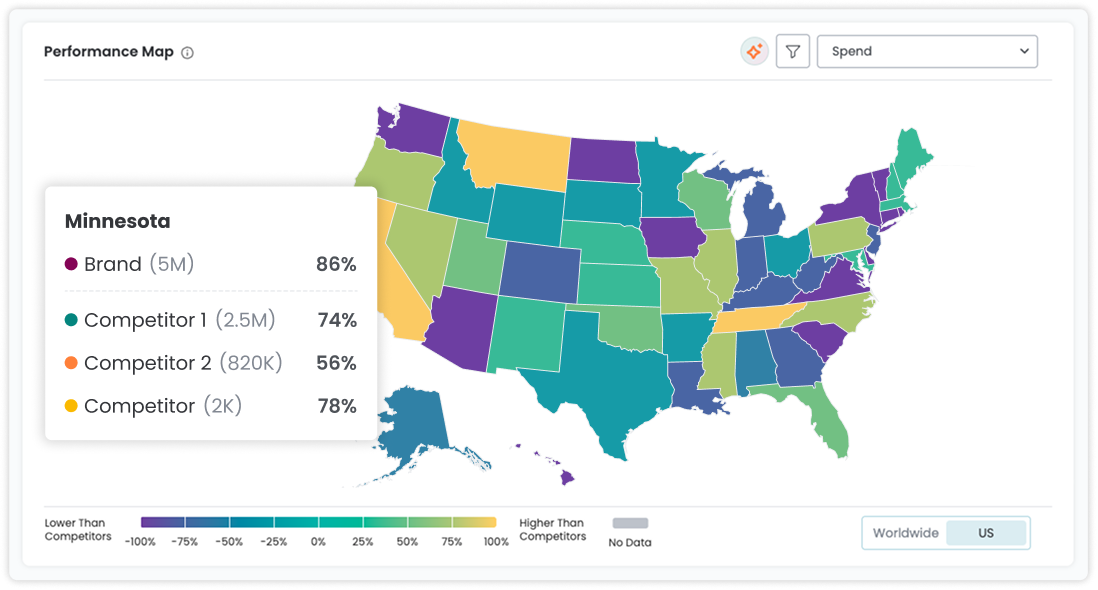
For this engagement, we ran all ten candidate markets through POLARIS.AI™ to build a competitive picture city by city. We layered that view on top of the brand's existing sales performance data so we could see two things at once: where demand existed, and how expensive it was going to be to compete for it.
The output wasn't a ranked list. It was a map of trade-offs. Some markets had strong demand signals but were already saturated with competitor spend, which meant we'd be paying a premium to fight for incremental share. Other markets looked quieter on paper but had untapped audience segments competitors weren't pursuing.
What changed
The brand's 2026 expansion plan went from ten markets to five.
We took the markets that looked attractive on demand alone but were structurally expensive to compete in, and we set them aside. We redirected that budget into five markets where the brand could buy attention efficiently, against audiences competitors weren't actively targeting.
Same budget. Fewer markets. More room to actually win.
“The work we do for clients gets easier the moment everyone in the room can see the same picture. POLARIS.AI™ gave us that picture. The expansion plan that came out of it wasn’t just sharper, it was easier to defend, which matters when you’re asking a leadership team to make critical decisions about media dollars in a competitive category.”

Why this mattered beyond the plan
The bigger win wasn't the strategy itself. It was getting the room to agree on it.
Expansion decisions involve a lot of stakeholders, all of whom have opinions, and most of whom are looking at the same incomplete data from slightly different angles. When everyone is working from the same competitive picture, alignment gets easier. Disagreements get more productive. Decisions get made.
That's the part we don't always talk about in case studies. Good strategy work is half analysis and half giving executives a shared object to look at and discuss with intention.
The work behind the work
A media agency that's only a buying agency is a commodity. The platforms have made buying easier on purpose, because the more accessible they make it, the more money flows through them. What's hard, and what compounds value for the businesses we work with, is the layer above the buy. Knowing which question to ask. Knowing which signal to trust. Knowing when to walk away from a market that looks attractive on the surface.
Tools like POLARIS.AI™ are part of how we stay sharp at that layer. The strategy is the work. The buying is just the part everyone sees.
SMART MEDIA STARTS HERE.