
Virality Isn’t a Strategy
The latest “must-have” product isn’t showing up in stores. It’s showing up in group chats, classrooms, and algorithmic feeds.
Aidan Clark, Senior Account Strategist at Campfire Consulting, recently pointed to a phenomenon unfolding in middle schools: kids spending upwards of $50 on trending “squishy” toys, driven not by traditional advertising, but by what they see circulating on platforms like TikTok. In lower-income communities especially, the question isn’t just what’s trending, but how that demand is translating into real purchasing pressure at home.
That distinction matters more than it seems.
“People aren’t buying these products because they saw an ad,” Clark notes. “They’re buying them because their kids won’t stop talking about what they saw.”
It’s a subtle but important shift. The mechanism of influence has changed, but the underlying behavior has not.
The Illusion of a New Consumer
There’s a tendency in the industry to frame this moment as a complete reinvention of consumer behavior. In reality, it’s more of a redistribution of where influence originates.
A generation ago, the mall functioned as both a retail environment and a media channel. Kids encountered products in-store, built desire in real time, and made their case to parents on the spot. Today, that same dynamic plays out digitally. Discovery has moved upstream into feeds and content ecosystems, but the persuasion loop remains intact.
What has changed is the speed.
The compression of discovery, desire, and demand into a single scroll has created what can only be described as a “quickening” consumer cycle. Products can spike in awareness almost overnight, driven by repetition, social validation, and algorithmic amplification. The barrier to becoming “the thing” is lower than it has ever been.
But so is the barrier to irrelevance.
The Short Half-Life of Virality
The industry’s obsession with virality often overlooks a fundamental truth: most viral products decay as quickly as they rise.
Clark points to search behavior as a proxy for this volatility. Products that dominate conversation for a brief window often return to baseline just as quickly. Meanwhile, brands that invest in long-term relevance, utility, and trust maintain a far more stable presence over time.
The contrast becomes more apparent when you step back and look at search behavior over time.
Below are two trend views. One isolates interest in Labubu, a product that experienced a sharp surge in attention driven by social momentum. The second places that same trend alongside The Home Depot, a brand that has built demand steadily over decades.
What stands out is not just the spike, but the drop. Labubu’s search interest returns close to its pre-viral baseline almost as quickly as it rises. Meanwhile, Home Depot, without relying on trend cycles, maintains a consistent level of demand that viral products rarely sustain.
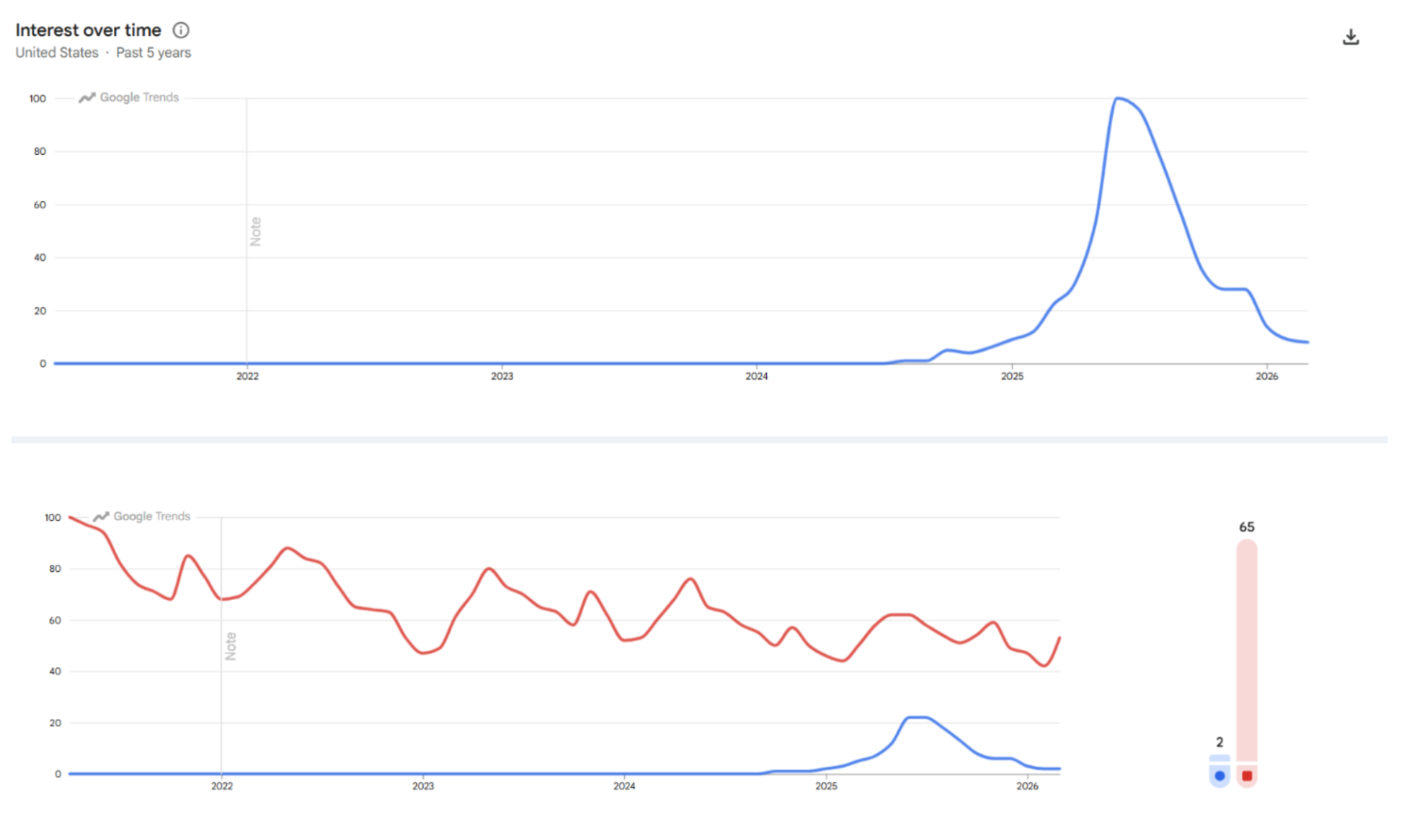
Search interest for viral products spikes quickly, but rarely sustains. Category leaders maintain steady demand over time.
A retailer like The Home Depot is not “viral” in any traditional sense. It is not driving trends on social platforms or dominating short-form video cycles. Yet its sustained search demand and cultural relevance are the result of decades of consistency, category authority, and trust.
That contrast highlights the core issue: virality is a spike, not a strategy.
The Case for Anti-Virality
At Campfire, this is where the idea of anti-virality starts to take shape. Not as a rejection of reach or momentum, but as a reframing of what success actually looks like.
The trap many brands fall into is equating short-term conversion spikes with long-term growth. Weekly performance reports reinforce this bias, rewarding immediacy over durability. But optimizing exclusively for what works now often comes at the expense of what works over time.
Clark outlines five fundamentals that consistently underpin durable brands:
Value
Trust
Differentiation
Consistency
Context
These are not new ideas. What’s changed is how easy it has become to deprioritize them.
Virality, by design, emphasizes novelty over consistency. It rewards participation in trends rather than ownership of a narrative. And while it can create moments of outsized demand, it rarely builds the infrastructure required for sustained growth.
When Media Outpaces Meaning
There’s also a broader media implication here.
As platforms continue to optimize for engagement and efficiency, the industry has become increasingly focused on precision targeting and conversion-based outcomes. But as Clark points out, more efficient media does not automatically translate to more effective brands.
In many cases, it simply accelerates the same short-term behaviors.
This is where the distinction between media as a lever and media as infrastructure becomes critical. If the goal is to build something that lasts, the role of media shifts from capturing demand to shaping it over time.
That requires a different kind of discipline. One that often leads to harder conversations in reporting cycles, where the answer isn’t always “more spend” or “more conversions,” but a recalibration of what success should look like.
Persistence Over Production
The second-order effect of this shift is visible in content ecosystems as well. Platforms like YouTube have demonstrated that persistence often outperforms production value over time.
While high-production campaigns can generate attention, it is the consistent, repeated presence of content that builds familiarity and trust. The same principle applies to brands. Showing up over time, in the right context, with a clear and consistent message, compounds in a way that one-off viral moments cannot.
The Long Game, Reframed
The quickening consumer cycle isn’t going away. If anything, it will continue to accelerate as platforms, creators, and commerce become more tightly integrated.
But the takeaway isn’t that brands need to move faster.
It’s that they need to be clearer about what they’re building.
Virality can introduce a product to the market. It can create cultural moments and drive short bursts of demand. But it does not replace the foundational work required to become a brand that people return to, trust, and advocate for over time.
Anti-virality, in that sense, isn’t about avoiding attention. It’s about earning it in a way that lasts.
