

Pinterest Is Building a Media Company. Are You?
From CES to Possible, we have been watching Pinterest quietly rewire the relationship between inspiration, storytelling, and purchase. Their CTV move is not an ad product launch. It is a philosophy made actionable.
Back in January at CES, we sat in on a Pinterest session that did not get nearly enough attention. While the rest of the floor was busy talking about hardware specs and AI integrations, Pinterest was laying out something quieter and more consequential: a vision for long-form television content built around the things their platform has always done best. Interior design. Home styling. Aspirational living. Not ads dressed up as content. Actual programming, rooted in the intent signals of 600 million monthly users who come to the platform to plan, discover, and eventually buy.
We filed that away. It felt early. It also felt inevitable.
Then this past week at Possible in Miami, the other shoe dropped. Pinterest announced the launch of tvScientific by Pinterest, the first major product milestone following their acquisition of performance CTV platform tvScientific, which closed in February. For the first time, Pinterest advertisers can reach Pinterest audiences off-platform, on connected TV, across premium streaming inventory. The wall between inspiration and the living room screen is officially coming down.
What They Actually Built
This is not a standard CTV buy. What Pinterest has done is take its first-party intent data — built from 80 billion monthly searches, saves, boards, and browsing behaviors — and made it available as a targeting signal in connected TV environments. Through tvScientific's infrastructure and partnerships with major supply-side platforms, brands can now reach people on Hulu, Peacock, and beyond, using the same signals that tell you someone is actively planning a kitchen renovation or researching a stroller purchase.
That distinction matters. Most CTV targeting relies on demographic proxies or third-party behavioral data of questionable freshness. Pinterest's signals reflect what people are planning right now, not what they bought six months ago.
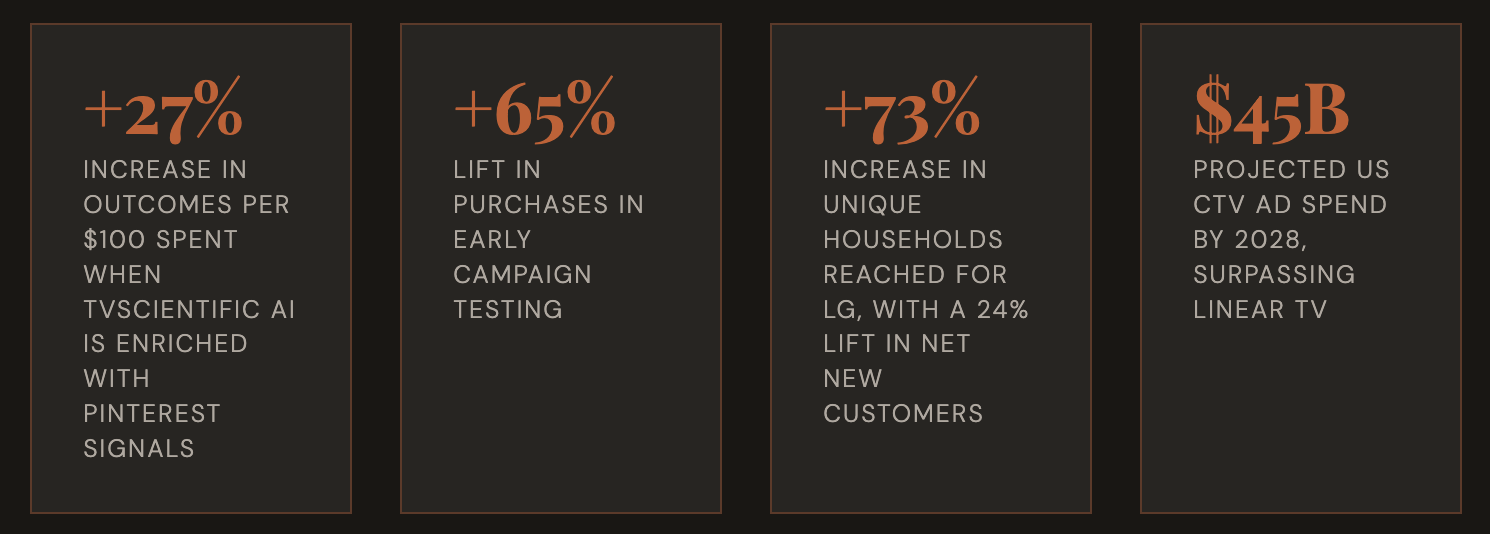
Those numbers, reported by Pinterest at launch, are early. But the direction is clear, and the logic behind them is sound.
The Bigger Story Nobody Is Telling
Here is what the trade press mostly missed in covering this as a media buy story: Pinterest is not launching an ad product. They are completing an ecosystem. The CES programming announcements were chapter one. This is chapter two. They are building the content, building the audience, and now connecting the commercial infrastructure to close the loop between a viewer watching a beautifully produced design show and a brand reaching that same person while they are in that mindset.
That is what we mean when we say brands should operate like media companies. Not that they should run ads. That they should build content worth seeking out, grow an audience that chooses to follow them, and then activate that relationship in ways that feel earned rather than intrusive. Pinterest has spent years doing exactly that at scale. The tvScientific acquisition is what happens when a platform fully commits to that model.
“You cannot build a loyal audience by solely buying one. You build it by showing up with something worth following and tuning in for, consistently, over time. Then the media strategy almost takes care of itself.”
We have been saying this to clients for years. The brands that win long-term are not the ones that found the lowest CPM or the best retargeting stack. They are the ones that built something people actually wanted to pay attention to. Campfire's whole orientation around the Familiarity Pathway starts with that premise. Familiarity is not a frequency problem. It is a story problem. If your story is good and your channels are right, the lift follows.
What This Means for Challenger Brands Specifically
For the mid-market brands we work with — the regional-to-national challengers who do not have a $50 million linear TV budget sitting around — this development is meaningful for a few reasons.
First, it lowers the creative barrier. AI-powered production tools are driving down the cost of CTV-quality creative to a fraction of what it cost five years ago. While nice to have, you no longer need a broadcast production house to show up credibly on a connected TV screen. That democratization is real and accelerating.
Second, attribution for CTV — the category tvScientific helped pioneer alongside a handful of others — is built for accountability. This is not awareness-only television. Campaigns are optimized toward outcomes and measured against actual business results. That makes it a conversation a growth-stage brand can actually have with their CFO.
Third, and most importantly, if you have been investing in building a genuine community around your brand — an email list, a content program, a podcast, a loyal social following that means you are sitting on first-party data that has real value in this environment. It’s not new, but the fact more leaders are finally tapping into what they have sure is. The brands that own their audience do not have to rent someone else's. That has always been our position. Pinterest's architecture is validating it in a very public way.
The Wrinkle Worth Watching
There is a tension embedded in all of this that deserves honest acknowledgment. The CTV ecosystem is fragmenting fast. Subscriber churn on legacy streaming platforms is significant, and the monetization pressure on those services is only growing. Every new participant in the CTV advertising marketplace — Pinterest included — adds supply-side complexity while also putting more strain on an already crowded inventory landscape.
Whether Pinterest's intent-signal advantage holds as the space gets more competitive is an open question. First-party data is only as valuable as the platform's ability to maintain user trust and engagement. Pinterest has been better than most on that front — their users genuinely come to the platform with a different mindset than they bring to other social networks. Less performative. More purposeful. That distinction is the foundation of everything they are building commercially. If they protect it, they have something durable. If they erode it chasing ad revenue, they will look a lot like everyone else.
We will be watching. And we will be back at the next conference where they announce chapter three.
The Takeaway for Your Brand
If you are a brand that has been sitting on the sidelines of CTV because it felt too expensive, too complicated, or too disconnected from your marketing goals, the landscape is shifting in your direction. The tools are better. The measurement is more honest. And now one of the most intent-rich platforms on the internet is plugging its audience data directly into the TV screen.
But the brands that will get the most out of this are the ones who already have a story worth telling. Not a product message. A point of view. A community. A reason someone would choose to follow you on a Tuesday afternoon. That is the work that makes everything else compound.
If you want to talk through what that looks like for your business, you know where to find us.
