

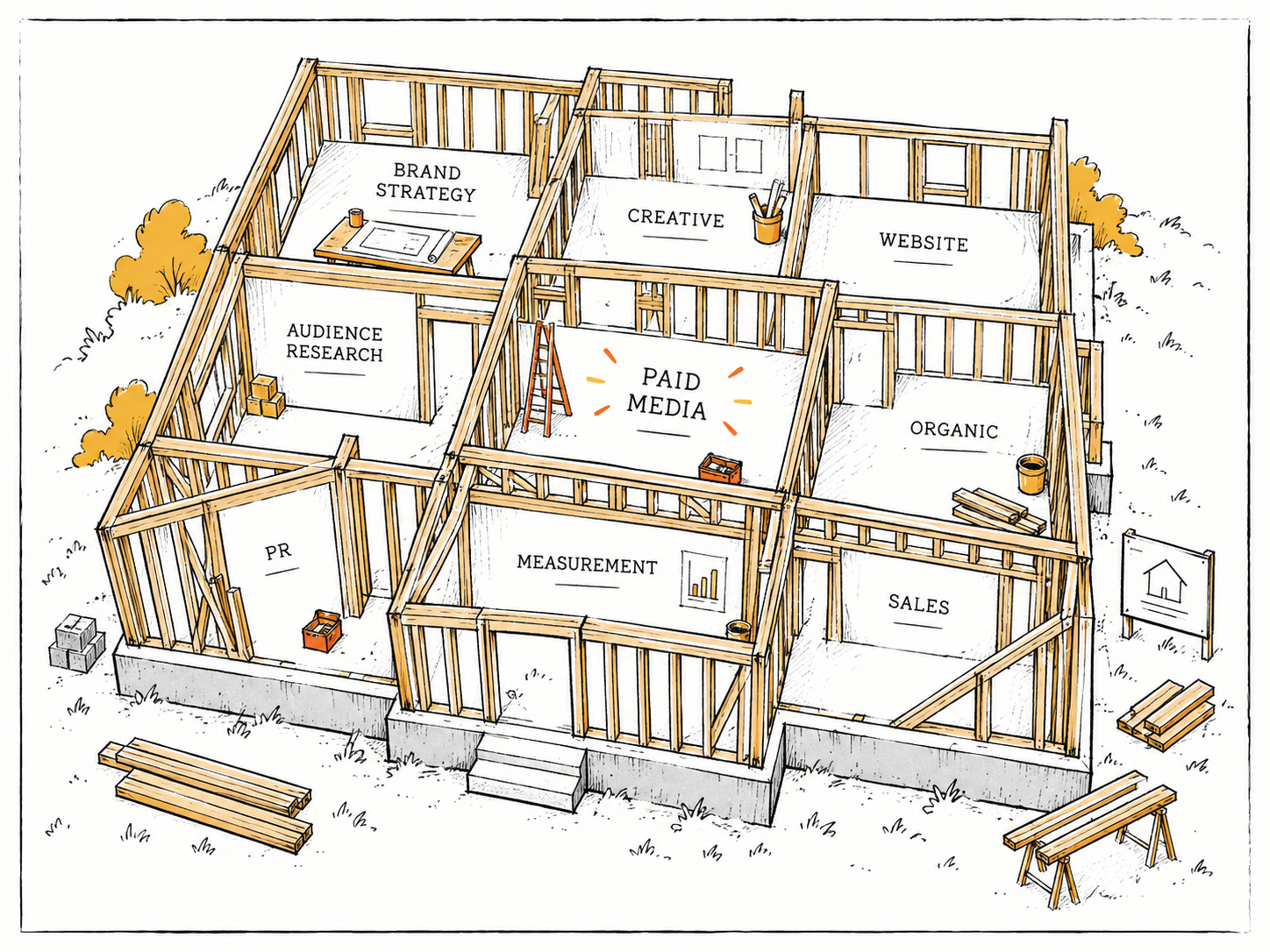
Paid Media Is Part of the House
There’s a phrase we hear surprisingly often when talking with brands, agencies, and organizations about media. “We need to get the house in order first.”
Usually that means the website needs some work. Messaging is being revisited. A new brand strategy is underway. Creative is still being developed. Maybe somebody is trying to get a better handle on the customer journey or measurement infrastructure. Once all of that is settled, the thinking goes, then we’ll be ready to talk about paid media.
It sounds responsible. The problem is that by the time you’ve gotten the house in order, you may have already made a series of decisions that limit what your media investment can actually do.
At Campfire, we don’t think paid media should be what happens after the marketing strategy is finished. It should be one of the inputs helping shape that strategy in the first place. That doesn’t mean a media agency suddenly needs to become your brand agency, web developer, PR firm and sales consultant. It means that if you’re planning to spend hundreds of thousands, or millions, of dollars putting a brand in front of people, the people responsible for figuring out who those people are, where they spend their time and what might actually move them should probably be involved before every meaningful decision has already been made.
This becomes especially important for brands and nonprofits that don’t have unlimited awareness or unlimited audiences. Every organization has some kind of ceiling with the people it can realistically reach. Some audiences already know you. Some have never heard of you. Some are highly likely to buy, donate or participate once they understand what you offer, while others may never be worth the cost of pursuing. But understanding an audience goes well beyond defining a demographic or building another targeting segment. It means understanding what people care about, how the category is already speaking to them, where your brand has room to differentiate, which communities they belong to and which media environments already have their attention and trust.
That’s the work we think should happen before the media plan, not after it. We call it Audience Planning. We bring together first-party data, behavioral research, competitive intelligence, local-market signals and what we’re seeing in media to understand not only who matters, but what may actually matter to them. Sometimes that confirms the existing brand strategy. Sometimes it creates a sharper creative brief. Sometimes it exposes an audience or market opportunity the business hadn’t considered. And sometimes it challenges the message entirely. Our approach intentionally sits at the intersection of audience, message, market, media and measurement, rather than assuming all of those decisions can happen independently.
That isn’t a media agency wandering into somebody else’s lane. It’s the reality that what you say and where you say it were never really separate decisions to begin with.
Creative is one of the easiest places to see this play out. Kantar has repeatedly found creative quality to be one of the most important controllable drivers of advertising effectiveness, while its research has also shown that strong creative becomes even more effective when it works cohesively across channels.
Anybody who has worked in media has seen what happens when that conversation occurs too late. The campaign gets developed first. Then the finished assets arrive and everyone starts figuring out how to make them fit the environments where people will actually see them. The horizontal video becomes vertical. The thirty becomes a fifteen. The campaign idea conceived for one context gets squeezed into five others. Sometimes that’s unavoidable, but there’s a pretty big difference between adapting creative for media and developing creative with an understanding of how an audience is actually going to experience it.
Websites aren’t much different. One of the first things we want to understand when we begin working with a client isn’t simply where someone can click. We want to understand what happens after they do. What does the current journey look like? What should it look like? Which behaviors actually matter to the business? Which ones can we measure? Where are people dropping out? Does somebody encountering the brand for the first time need a different experience than an existing customer who already understands what makes the product valuable?
That’s why user journey mapping happens early in our process. We look at audience media consumption alongside the path to purchase, then examine both the existing and ideal buying flow so we can identify the actions worth tracking and the places where media, measurement or the customer experience itself may need work. Sometimes the media strategy surfaces a website problem. Sometimes audience research creates a messaging question. Sometimes the measurement conversation reveals that the business wants to optimize toward an outcome it isn’t technically set up to measure yet. Those are useful discoveries to make before a campaign is live, not six weeks into reporting.
The same applies to the media channels themselves. Before we get into tactical planning, we spend time understanding the existing media ecosystem, historical performance, potential new channels and the business outcomes those channels are being asked to influence. We also look at whether those outcomes can realistically be measured and what role each channel is supposed to play. Not every channel has a direct line to ROAS, and our process explicitly establishes channel roles and measurement feasibility before a media plan is built.
That last part matters because marketing has developed a strange habit over the past decade. We’ve become so focused on proving that every individual media dollar generated something immediately measurable that we sometimes forget how people actually make decisions.
Profit Ability 2, an econometric study covering 141 brands and approximately $2.4 billion in advertising spending, found that 58% of advertising’s total profit generation happened after the first 13 weeks. Generic paid search produced particularly strong immediate payback, but its effects diminished rapidly after the first week and its sustained contribution was considerably weaker. That doesn’t make search ineffective. It means search is doing a different job from channels creating familiarity and demand over a longer period.
The IPA has been pushing on a similar problem. In its 2026 Go Big or Go Home report, Les Binet and Will Davis argue that marketing has become overly focused on short-term efficiency and narrow metrics at the expense of broader effectiveness and business growth. Their point isn’t that efficiency doesn’t matter. It’s that eventually there is a ceiling to how much growth can come from squeezing harder on the people already closest to conversion.
This is where the idea of “getting the house in order” starts to fall apart for us.
Media is already part of the house.
It should influence how you think about the audience, what creative you need, how the website is structured, what data needs to be collected, when PR should hit, how events can be amplified and where organic marketing or sales can do part of the job more effectively than another paid impression. If we understand an upcoming event, we can think about how media surrounds it. If we know the organic strategy, we can avoid paying to accomplish something another channel is already doing. If we’re talking with sales, we may learn that the customers delivering the most value look different from the audience marketing has traditionally prioritized. Our own briefing process deliberately brings PR, events, organic marketing and sales into the media conversation for exactly this reason.
Even the order of operations matters. Our process begins with goal setting and development of the media brief, followed by identifying creative and web implications. Tactical media planning comes after that. Only once the strategy is aligned do we get into vendor evaluation, negotiation, measurement requirements, execution and launch. It takes more work upfront than opening a spreadsheet and deciding what percentage of the budget belongs in search, social, streaming television or anything else, but it also gives those dollars a much better chance of doing something meaningful for the business.
None of this means every organization needs to bring its media agency into every meeting. There are plenty of decisions where we don’t belong, and there are specialists in brand, creative, PR, web development and other disciplines whose craft we have no interest in pretending to replace. In fact, our Audience Planning work is often most valuable when it gives those partners better information to work from. We can bring the audience intelligence, market context and media signals that sharpen the brief while the people who specialize in creative translate that thinking into the actual work.
That connective tissue is the point.
The best brands and nonprofits we work with tend to understand this instinctively. They know the story they’re trying to tell, but they’re also willing to let what they learn about people change that story. They’re clear about who they need to reach and realistic about where their growth can come from. They understand that audience, brand, creative, media, measurement and customer experience may be different disciplines, but the person on the other end experiences all of them as one thing.
And that’s really the issue with waiting to “get the house in order.”
If you finish the website, finalize the messaging, approve the creative, establish the measurement plan and decide who your growth audience is before seriously thinking about paid media, you aren’t protecting your media investment. You’re asking it to work around a house it had no role in designing.
Paid media isn’t the thing you move in after the construction is finished. It’s part of the house.
A note on how this was made. These thoughts and words are our own. We did use AI as an editing tool to help structure the narrative, tighten the writing and keep the ideas focused. The experiences, opinions and point of view are our own and our process cited is based on the way we actually move through the work with regional challenger and national scaling brands.
