

America at 250: The Media That Made Us
By Chris Marine, Founder & CEO, Campfire
From specialty cups to eagle-shaped meals to every star-spangled banner you can slap a logo on, brands are lining up to salute the 250th. Good for them.
We're going to do something different.
Because if you want to talk about what this country is actually built on, start with the media that kept the whole experiment honest. Not the algorithm. Not the upfront. The free press. The idea that if people have access to real information, they can govern themselves and run their own markets. That idea is older than the Constitution and more foundational than most brand campaigns will ever be.
I started my career in a newsroom. Then I moved to the sell side, representing television networks, radio stations, adtech, and publishers. Then to the buy side, sitting across the table from all of them. That full trip through the machine is why Campfire exists and why we think about paid media the way we do. When you've seen every side of a transaction, you get a lot harder to BS.
So here's our 250th anniversary piece. Not a limited-edition cup. A look at how American media traveled from a printing press and a revolution to a programmatic auction clearing in milliseconds, and what that entire arc means for anyone buying media today.
The line from 1776 to your Q3 plan is shorter than you think.
ACT I: Media Builds the Public Square
The Press Was the Platform
When the Continental Congress approved the Declaration of Independence in 1776, it wasn't enough to write it. It had to spread. The Declaration wasn't just a political document. It was one of the most influential pieces of media in American history. The text was published in the Pennsylvania Evening Post, and from there it moved from colony to colony through a network of printers, editors, and readers who understood that information in motion was power.
Before America had a federal government, it had an information network.
Newspapers weren't simply recording the Revolution. They were helping create it. Ideas moved from city to city because printers kept putting them in front of readers. Long before anyone talked about network effects, the colonial press had already become one.
The First Amendment, ratified in 1791, codified what the press had already proven: that the ability to publish freely was inseparable from the ability to self-govern. It's worth noting that free speech and freedom of the press are listed separately and intentionally. They are not the same right. One protects the individual. The other protects the institution. The Postal Service Act of 1792 wasn't just transportation policy. It was media policy. The founders believed an informed public was infrastructure just as surely as roads and ports were. If ideas couldn't travel, neither could democracy.
The penny press arrived in the 1830s and changed the economics of everything. It didn't just make newspapers cheaper. It changed who newspapers worked for. Lower prices meant publishers needed more readers. More readers meant they needed more advertisers. For the first time in American history, the economics of mass attention began reshaping journalism itself.
As journalism grew, so did the expectation that it should do more than simply share information. It began evolving into a profession built on credibility. Reporters increasingly worked to verify facts, distinguish news from opinion, and earn the public's trust. Those ideas weren't universally practiced yet, but they laid the foundation for the role journalism would come to play in American society.
It didn't take long for publishers to discover that attention could be monetized. Accuracy built trust, but sensationalism sold papers. The rise of yellow journalism in the late 19th century showed that when attention becomes the product, the information itself starts to bend. That tension has never really disappeared. Every major medium since has wrestled with the same question.
When attention becomes the product, what happens to the information?
Radio Rewired the Country
Radio wasn't invented to sell advertising. It was invented because people were captivated by a new way to communicate. In November 1920, Westinghouse's KDKA in Pittsburgh became the first licensed commercial broadcast station in the United States, airing the Harding-Cox election returns to whoever happened to be listening.
Within four years, more than 1,400 radio stations existed across the country. For the first time in American history, millions of people were having the same experience at the same moment, across geographic and economic lines. Radio created a shared national identity almost by accident, simply by existing.
Then businesses noticed. In 1922, a real estate developer in New York City became the first brand to buy radio airtime. Almost overnight, a medium built to connect people became a commercial engine. The first broadcasters didn't build the audience to sell ads. They built the audience because the medium itself was extraordinary. The commercialization came later, as the audience proved its scale.
That pattern would repeat.
Television and the Responsibility Question
On July 1, 1941, NBC's WNBT in New York aired the first legal television commercial in American history. It was a 10-second Bulova watch spot that ran before a Brooklyn Dodgers game. The entire thing cost Bulova nine dollars. There were roughly 4,000 televisions in New York City at the time.
The next two decades reshaped not only media, but culture itself. Television wasn't just a bigger newspaper or a better radio. It changed how humans processed information. When sight, sound, and storytelling came together on a screen, media stopped being something people simply consumed and became something they experienced. Television established the grammar of modern visual media, and every screen that followed has spoken its language. It put the civil rights movement in American living rooms. It put a moon landing there too. It built the consumer economy through a new kind of persuasion that print and radio couldn't touch.
Philo Farnsworth, who developed the first fully functional all-electronic television system in 1927, understood the weight of what he'd built. He's been quoted saying that television was "a gift of God, and God will hold those who utilize his divine instrument accountable to him." That's a serious statement from the man who made the whole thing possible. He imagined it as a teaching tool. A way to bring the world into living rooms everywhere.
What it mostly became was a vehicle for selling things. The advertising model that funded radio became the advertising model that funded television, scaled up enormously. The 30-second spot became the atomic unit of American culture. The upfronts were born. The network era took hold. And for about 40 years, three broadcast networks and a handful of local stations controlled what 200 million Americans watched each night.
ACT II: Commercial Incentives Reshape Media
The Internet Arrived With a Banner Ad
One thing I've learned studying media is that most of its biggest turning points didn't begin with bad intentions. They began with people trying to solve real problems.
The internet needed a business model. Publishers still had writers to pay, editors to employ, and journalism to produce. When HotWired introduced the banner ad in October 1994, it wasn't trying to create an attention economy. AT&T paid $30,000 for three months of space. The click-through rate was 44 percent, because users had never been invited to interact with an ad before. They clicked out of curiosity. HotWired borrowed a model that had worked for magazines for generations and brought it online.
The decision made perfect sense at the time. It's what happened next that changed everything.
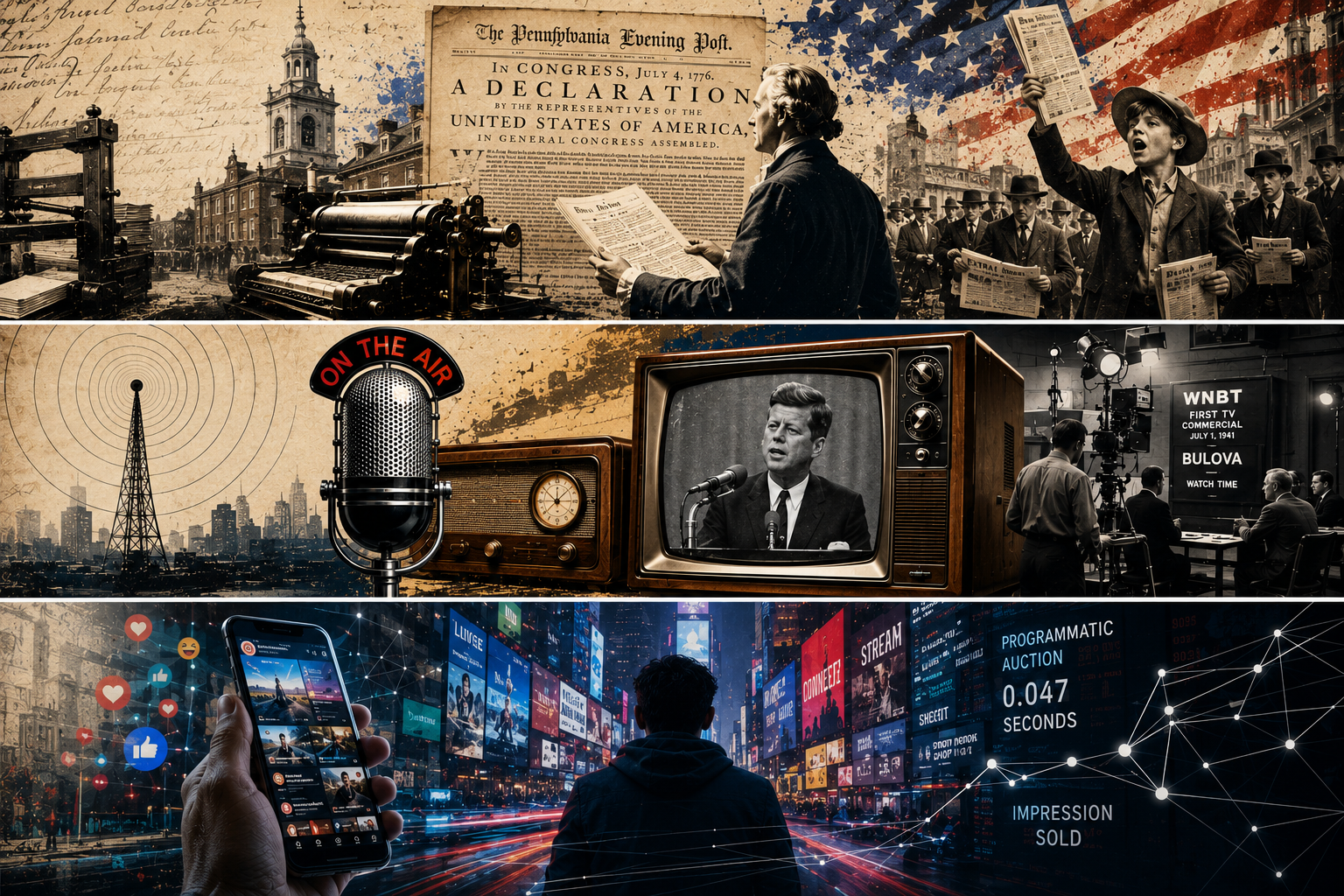
AI-generated editorial illustration created with OpenAI. Historical imagery is symbolic and intended to visualize the themes discussed in this article.
Google launched AdWords in 2000. Facebook launched its advertising platform in 2007. In the early 2010s, programmatic advertising automated the buying and selling of ad inventory in real time, removing much of the human judgment from the transaction. More than 80 percent of digital display ads are now bought programmatically. The $30,000 AT&T paid HotWired for three months has become a global industry accounting for nearly three-quarters of all digital advertising spend worldwide.
The banner ad changed how publishers were funded. Smartphones and social media changed how people behaved.
The iPhone launched in 2007. By early 2012, nearly half of all American adults owned a smartphone. Instagram exploded into mass adoption that same year. By 2014, the algorithmic feed had become the dominant architecture of how people communicated, consumed information, and formed opinions. Social psychologist Jonathan Haidt called the period from 2010 to 2015 "the great rewiring" — the moment a phone stopped being a communication device and became a portal to an infinite feed optimized not for connection, but for engagement.
And engagement, as every media professional knows, is a proxy metric, not a business outcome. It measures attention captured. It says nothing about what that attention does to the person on the other end of the transaction.
The same platforms brands were flooding with ad dollars were simultaneously rewiring how people process information, form trust, and relate to each other. The medium was never neutral. It just took a decade for enough people to say it out loud.
The Pattern
By now it's hard to ignore.
Innovation. Commercialization. Concentration. Reckoning.
Every time. The press. Radio. Television. The internet. Algorithms. Each one arrived with genuine promise. Each one developed a commercial model. Each one bent toward concentration as that model scaled. And each one eventually produced a reckoning over trust, quality, and the public good.
The way we fund media eventually changes the media we create. Over time, the media we create changes us.
None of this is destiny. It's a choice that gets made, and remade, at every stage. The question is whether we make it consciously.
ACT III: Marketers Now Have Agency
The medium is never neutral. Every channel you buy has a history, an ownership structure, an economic incentive, and a relationship with its audience that predates your campaign. That context shapes how your message lands and what it means to be there. Buying cheap impressions on a platform that is actively eroding user trust is not a neutral act. It's a vote.
Ad budgets are not passive. They are active decisions about which media properties survive, which ones scale, and which ones disappear. Every dollar is a vote on what the media landscape looks like in ten years.
One of the reasons I care about this isn't because I dislike advertising. I chose this industry. I love this industry. Advertising has funded some of the greatest journalism, entertainment, and cultural moments in American history. The question has never been whether advertising belongs in media. It's whether the incentives behind it still align with the public good.
Every medium in history has eventually produced a counter-movement. Yellow journalism helped push journalism toward stronger professional standards. Broadcast consolidation helped make the case for public broadcasting. And now, quietly, something is shifting again. People are leaning back into the real world. Investment in local media, community experiences, and environments where people are actually present with each other is building back the kind of mental availability that performance metrics never measured but that built every durable brand in American history.
The revolutionary leaders who started this country didn't have consensus on their side. They had conviction, a free press to amplify it, and a small group of people willing to act on a new playbook. Every notable movement in American history started exactly that way.
The country is 250 years old. The press has been here for all of it. Every generation has inherited a media system shaped by the incentives of the one before it. What happens next depends on whether the people who fund today's media decide it's worth protecting.
Campfire is a strategy-first paid media agency. We help brands translate existing brand frameworks into accountable paid media strategy, using deep audience research, platform-agnostic channel planning, and measurable business outcomes. If you're ready to think differently about where your media dollars go and why, let's talk.
